Fermentation technology has transformed modern industries by enabling the large-scale production of pharmaceuticals, enzymes, vaccines, biofertilizers, food products, and industrial chemicals. At the heart of every successful fermentation process is a fermenter, a specialized vessel designed to provide the ideal environment for microorganisms or cells to grow and produce valuable products.
Whether you are involved in biotechnology, pharmaceuticals, agriculture, food processing, or research, understanding what is a fermenter, how it works, and its industrial applications is essential. Choosing the right fermenter not only improves productivity but also ensures consistent product quality and process efficiency.
In this blog, we’ll explore What Is a Fermenter? Types, Working Principle & Applications, along with its key components, benefits, and how Fermenter Technologies delivers reliable fermentation solutions for diverse industries.
What Is a Fermenter?
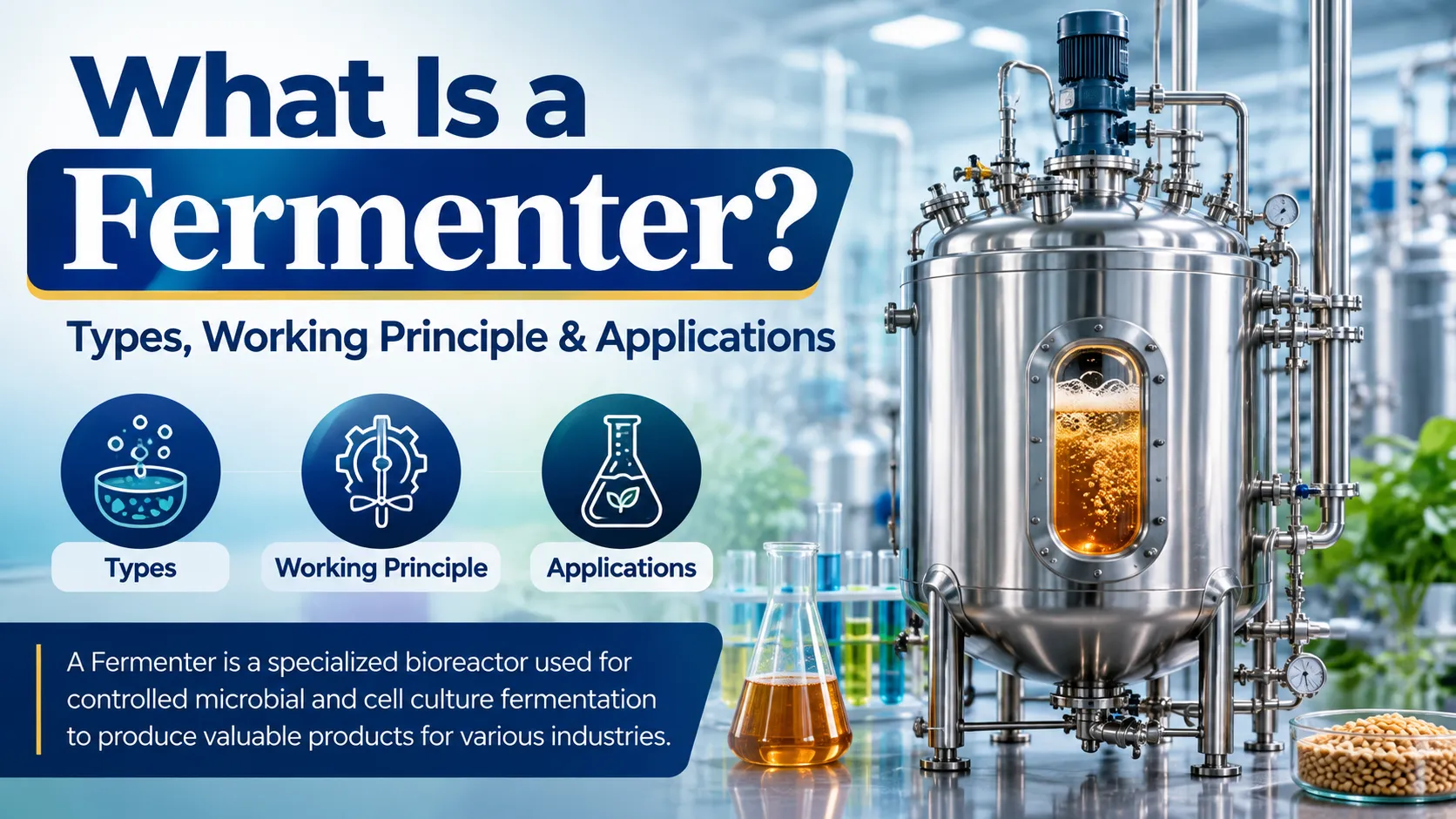
A fermenter is a specially designed, closed vessel used to cultivate microorganisms such as bacteria, yeast, fungi, or animal and plant cells under controlled conditions. It provides the ideal environment by maintaining critical process parameters like temperature, pH, dissolved oxygen, agitation, pressure, and nutrient supply.
The primary objective of a fermenter is to maximize microbial growth and product formation while preventing contamination. Modern fermenters are equipped with automated control systems that continuously monitor and adjust operating conditions, ensuring high productivity and consistent results.
Fermenters are widely used in laboratories for research, pilot-scale production for process optimization, and large industrial facilities for commercial manufacturing.
Also Read: What is a Stirred Tank Bioreactor? Working Principle, Design & Applications
How Does a Fermenter Work?
Understanding the working principle of a fermenter helps explain why it plays such a crucial role in industrial biotechnology.
The process begins by sterilizing the fermenter to eliminate unwanted microorganisms. Once sterilization is complete, the required nutrient medium is introduced into the vessel. A selected microorganism or cell culture is then inoculated into the sterile medium.
During fermentation, the fermenter continuously maintains optimal environmental conditions. Agitators ensure proper mixing, while aeration systems supply oxygen for aerobic fermentation. Sensors monitor temperature, pH, dissolved oxygen, foam levels, and pressure, allowing the control system to make automatic adjustments whenever necessary.
As microorganisms consume nutrients, they produce valuable products such as enzymes, antibiotics, organic acids, vaccines, ethanol, biofertilizers, proteins, and probiotics. After the fermentation cycle is complete, the final product is recovered and processed further according to industrial requirements.
Main Components of a Fermenter
Every fermenter consists of several important components that work together to maintain an ideal fermentation environment.
Vessel
The stainless steel vessel provides a sterile chamber where microorganisms grow and fermentation takes place.
Agitator
The agitator continuously mixes the culture medium, ensuring uniform distribution of nutrients, oxygen, and temperature throughout the vessel.
Aeration System
Air or oxygen is introduced through spargers to support aerobic microbial growth and maintain dissolved oxygen levels.
Temperature Control System
Heating and cooling jackets maintain the precise temperature required for efficient fermentation.
pH Control System
Automatic pH monitoring and dosing systems ensure the culture remains within the desired pH range.
Sensors
Modern fermenters include sensors for dissolved oxygen, pressure, temperature, foam, and liquid level monitoring.
Control Panel
Advanced PLC or SCADA-based control systems automate process monitoring and improve production consistency.
Types of Fermenters
Different industries require different fermentation processes, making it important to choose the right type of fermenter.
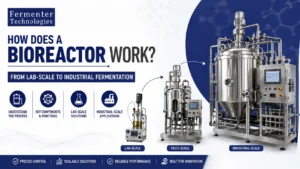
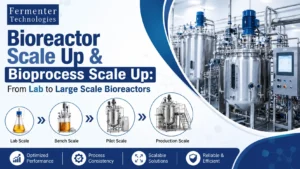
Lab Scale Fermenter
Lab scale fermenters are primarily used for research, product development, educational institutions, and laboratory experiments. They help researchers optimize fermentation conditions before scaling up production.
Pilot Scale Fermenter
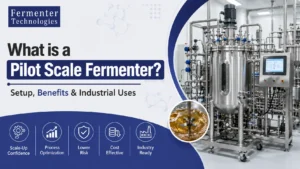
Pilot scale fermenters bridge the gap between laboratory research and commercial manufacturing. They are used to validate production processes, evaluate product quality, and optimize operating parameters.
Industrial Production Fermenter
Industrial fermenters are designed for continuous, large-scale manufacturing. They are widely used in pharmaceutical companies, biotechnology industries, food processing plants, enzyme production facilities, and biofertilizer manufacturing units.
Stainless Steel Fermenter
Stainless steel fermenters offer excellent corrosion resistance, easy cleaning, long service life, and compliance with GMP standards. They are the preferred choice for pharmaceutical and biotechnology applications.
Customized Fermenters
Many industries require specially designed fermenters tailored to unique production processes, media compositions, or operating conditions. Customized solutions improve productivity while meeting specific manufacturing requirements.
Advantages of Using a Fermenter
Modern fermenters provide numerous advantages that improve production efficiency and product quality. One of the biggest benefits is precise process control. Automated systems continuously monitor critical parameters, reducing human error and ensuring consistent fermentation performance.
Sterile operating conditions minimize contamination risks, resulting in higher product quality and improved process reliability. Efficient mixing and aeration maximize microbial growth, increasing production yield while reducing fermentation time.
Modern fermenters also offer excellent scalability, allowing industries to transition smoothly from laboratory research to full-scale commercial production. Additionally, advanced automation reduces operating costs, improves energy efficiency, and simplifies process management.
Industrial Applications of Fermenters
Fermenters have become essential equipment across numerous industries because of their versatility and efficiency.
Pharmaceutical Industry
Fermenters are extensively used to manufacture antibiotics, vaccines, insulin, hormones, enzymes, and other life-saving pharmaceutical products.
Biotechnology Industry
Biotechnology companies rely on fermenters for cell culture, recombinant protein production, genetic engineering research, and biopharmaceutical manufacturing.
Food & Beverage Industry
Fermenters support the production of probiotics, dairy products, yeast, vinegar, organic acids, beverages, and various fermented food products.
Agriculture Industry
Biofertilizers, bio-pesticides, microbial inoculants, and sustainable agricultural products are manufactured using industrial fermenters.
Enzyme Manufacturing
Industrial enzymes used in detergents, textiles, food processing, and paper manufacturing are produced through controlled fermentation processes.
Biofuel Industry
Fermenters play a significant role in ethanol production and renewable biofuel manufacturing by converting biomass into sustainable energy sources.
Research & Educational Institutions
Universities, research laboratories, and biotechnology institutes use laboratory fermenters for scientific studies, innovation, and process development.
Factors to Consider When Choosing a Fermenter
Selecting the right fermenter depends on several technical and operational requirements. Production capacity should match current and future manufacturing needs. The fermenter material should be durable, corrosion-resistant, and suitable for the intended process.
Automation capabilities are equally important, as modern control systems improve consistency, reduce manual intervention, and enhance process efficiency.
Ease of cleaning through CIP (Clean-in-Place) and SIP (Sterilization-in-Place) systems helps maintain sterile conditions while reducing downtime.
Reliable technical support and after-sales service also play an important role in ensuring long-term operational success.
Why Choose Fermenter Technologies?
At Fermenter Technologies, we specialize in designing and manufacturing high-performance fermenters and bioprocess equipment for research laboratories, biotechnology companies, pharmaceutical manufacturers, food processing industries, and industrial production facilities.
Our product range includes lab-scale fermenters, pilot-scale fermenters, industrial fermenters, customized bioreactors, and complete fermentation systems designed to deliver outstanding performance, reliability, and long service life.
Every system is engineered using premium-grade stainless steel, advanced automation, and precision control technology to ensure maximum process efficiency and product quality.
Our experienced engineering team works closely with clients to understand their production goals and deliver customized fermentation solutions that improve productivity while meeting international quality standards.
From equipment selection and system design to installation, validation, training, and after-sales support, Fermenter Technologies provides complete end-to-end solutions for every fermentation requirement.
Conclusion
Understanding What Is a Fermenter? Types, Working Principle & Applications is essential for industries looking to improve productivity, maintain product quality, and achieve reliable fermentation performance.
A fermenter provides the controlled environment required for successful microbial growth and product formation, making it one of the most valuable pieces of equipment in biotechnology, pharmaceuticals, agriculture, food processing, and industrial manufacturing.
Whether you require a laboratory fermenter for research, a pilot-scale unit for process development, or a fully automated industrial fermentation system, choosing the right equipment directly impacts production efficiency and long-term success.
With advanced engineering expertise, customized solutions, and dependable technical support, Fermenter Technologies is committed to delivering innovative fermentation systems that help businesses achieve higher productivity, consistent quality, and sustainable growth.
Frequently Asked Questions (FAQs)
1. What is a fermenter?
A fermenter is a controlled vessel used to grow microorganisms or cells under sterile conditions for producing products such as antibiotics, enzymes, vaccines, biofertilizers, and food ingredients.
2. What are the different types of fermenters?
The main types include lab-scale fermenters, pilot-scale fermenters, industrial production fermenters, stainless steel fermenters, and customized fermenters for specific applications.
3. How does a fermenter work?
A fermenter maintains optimal temperature, pH, oxygen, agitation, and nutrient levels to support microbial growth and maximize product formation.
4. Which industries use fermenters?
Fermenters are widely used in pharmaceuticals, biotechnology, food and beverage processing, agriculture, enzyme manufacturing, biofuel production, and research laboratories.
5. Why choose Fermenter Technologies?
Fermenter Technologies provides high-quality, customized fermentation systems with advanced automation, reliable performance, expert engineering support, and complete turnkey solutions for research and industrial applications.