Developing a successful biological process at laboratory scale is only the first step. The real challenge begins when the process needs to be transferred from a small research vessel to a pilot or production system. This is where bioreactor scale up becomes important. A process that performs well in a 5 or 10-litre vessel may behave differently when transferred to a much larger system because mixing, oxygen transfer, heat removal, agitation, and fluid dynamics change with vessel size.
A properly planned bioprocess scale up approach helps maintain important process conditions while increasing production volume. Fermenter Technologies provides laboratory, pilot-scale, and production-scale bioreactor solutions designed to support this transition from research and development to commercial manufacturing.
What Is Bioreactor Scale Up?
Bioreactor scale up is the process of transferring a biological or fermentation process from a smaller bioreactor to a larger vessel while maintaining the critical conditions required for consistent performance.
The objective is not simply to increase the vessel capacity. A larger bioreactor changes the relationship between mixing, oxygen transfer, agitation, temperature control, pressure, and aeration. Therefore, engineers need to identify which process parameters must remain consistent during the transition.
For example, a microbial fermentation process developed in a laboratory bioreactor may require controlled pH, temperature, dissolved oxygen, agitation, and aeration. When moving to a pilot or production vessel, these parameters must be evaluated again to ensure that the biological process continues to perform effectively.
Also Read: How Does a Bioreactor Work? From Lab-Scale to Industrial Fermentation
Why Is Scale Up of Bioreactors Important?
The scale up of bioreactors allows companies to move from laboratory research toward pilot production and eventually commercial manufacturing. It is particularly important for biotechnology, pharmaceutical, enzyme, biofertilizer, probiotic, biopesticide, and other fermentation-based industries.
A well-planned scale-up strategy can help businesses:
- Increase production volume
- Maintain important process conditions
- Improve process consistency
- Evaluate production feasibility
- Reduce scale-up risks
- Optimize oxygen transfer and mixing
- Support commercial manufacturing
- Improve process monitoring and control
The goal is to achieve a larger production volume without losing the characteristics and performance established during laboratory development.
How Does a Scale Up Bioreactor Work?
A scale up bioreactor is designed to provide controlled environmental conditions at a larger working volume. Depending on the application, the system may include temperature control, agitation, aeration, pH control, dissolved oxygen monitoring, foam control, pressure monitoring, sampling arrangements, and automated process control.
During scale-up, engineers study how the process behaves as the vessel size increases. Factors such as impeller design, vessel geometry, agitation speed, airflow, oxygen transfer, and heat transfer can affect the final process.
Instead of simply increasing every parameter proportionally, the operating conditions are generally evaluated according to the biological process and the desired scale-up criteria.
Key Parameters Considered During Bioreactor Scale Up
Successful scale-up requires careful evaluation of several parameters.
1. Oxygen Transfer
Oxygen transfer becomes increasingly important in aerobic fermentation and cell culture. A larger vessel requires an appropriate combination of agitation and aeration to provide sufficient oxygen to the biological system.
The oxygen transfer capability of the bioreactor should therefore be evaluated before moving to a larger scale.
2. Mixing
Uniform mixing helps maintain consistent temperature, nutrient concentration, pH, and dissolved oxygen throughout the vessel.
As the vessel becomes larger, achieving the same level of mixing can become more challenging. Impeller configuration, agitation speed, vessel geometry, and fluid properties all influence mixing performance.
3. Agitation
Agitation supports mixing and can influence oxygen transfer. However, excessive agitation may negatively affect sensitive cells or biological materials.
For this reason, agitation conditions need to be selected according to the organism, cell type, medium properties, and process requirements.
4. Temperature Control
Temperature can directly influence biological growth and product formation. Larger bioreactors have different heat-transfer characteristics compared with laboratory vessels.
An appropriate temperature control system is therefore essential for maintaining stable process conditions.
5. pH Control
Many biological processes operate within a specific pH range. During scale-up, pH monitoring and automatic correction systems can help maintain the required process environment.
6. Foam Control
Fermentation and cell culture processes can generate foam because of aeration, proteins, nutrients, and agitation. Larger vessels may require effective foam detection and control arrangements to prevent operational problems.
From Laboratory Bioreactor to Pilot Scale
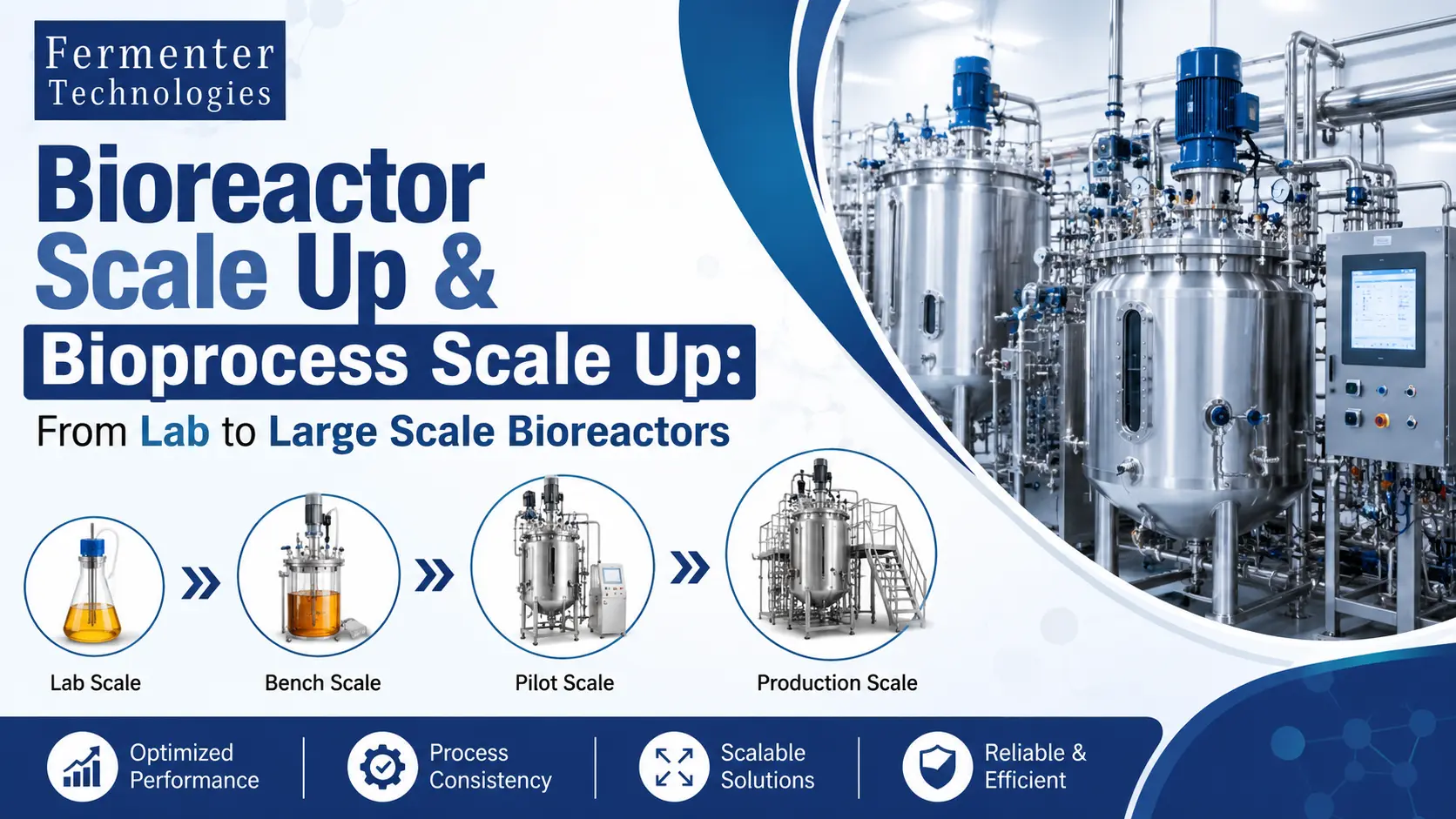
The transition from laboratory scale to pilot scale is an important stage in bioprocess scale up. Laboratory systems are generally used for process development, experimentation, and optimization, while pilot-scale equipment helps evaluate how the process behaves at a larger volume.
A typical development pathway may look like:
Laboratory → Kilo Lab → Pilot Scale → Production Scale
At every stage, the process should be evaluated before moving to the next level. This approach helps identify technical problems early and provides useful information for designing the final production system.
What Are Large Scale Bioreactors?
Large scale bioreactors are industrial systems designed for high-volume biological processing and commercial production. They are used when a validated process needs to be operated at significantly higher volumes than laboratory or pilot equipment.
Large-scale systems can be configured with advanced automation and process monitoring depending on the application. Typical parameters may include:
- Temperature
- pH
- Dissolved oxygen
- Agitation
- Aeration
- Foam level
- Pressure
- Feeding
- Sampling
- Cleaning and sterilization
The exact configuration depends on the process, production volume, biological material, and required level of automation.
Challenges in Bioprocess Scale Up
Moving from a small vessel to a large production system involves several technical challenges. The most important challenge is that physical conditions do not remain identical as the vessel size changes.
Common challenges include:
Maintaining oxygen transfer: Oxygen demand may increase significantly with production volume.
Achieving uniform mixing: Larger vessels require carefully selected agitation and impeller arrangements.
Managing heat transfer: Maintaining a stable temperature can become more demanding at higher volumes.
Controlling foam: Increased aeration and agitation may result in greater foam generation.
Maintaining product consistency: Process conditions must remain within suitable operating ranges to achieve consistent results.
Equipment integration: Sensors, automation, pumps, utilities, and control systems need to work together reliably.
Scale Up vs Scale Down in Bioprocessing
Scale-up focuses on moving a process from a smaller system to a larger production environment. Scale-down does the opposite by creating a smaller experimental model that represents important conditions of a larger production process.
Both approaches are useful in process development.
Scale-up helps determine whether a laboratory process can be transferred successfully to production, while scale-down models can help researchers investigate production-related problems without operating a full-scale system.
How to Choose a Bioreactor for Scale Up?
Selecting the right bioreactor depends on more than just vessel capacity. Before purchasing equipment, businesses should evaluate their process requirements carefully.
Important considerations include:
- Required working volume
- Type of biological process
- Aerobic or anaerobic operation
- Mixing requirements
- Oxygen transfer requirements
- pH and temperature control
- Dissolved oxygen monitoring
- Agitation system
- Automation requirements
- Cleaning and sterilization requirements
- Material of construction
- Future production requirements
It is also useful to consider whether the supplier can support the process from laboratory development through pilot and production stages.
Bioreactor Scale Up for Different Industries
Bioreactors are used across a wide range of industries where controlled biological processing is required.
Pharmaceutical Industry
Bioreactors can support research and production processes involving biological products, cell culture, and fermentation-based manufacturing.
Biotechnology
Biotechnology companies use bioreactors for microbial cultivation, cell culture, recombinant processes, and other biological applications.
Enzyme Production
Controlled fermentation environments can support the production of industrial and specialty enzymes.
Biofertilizer Production
Bioreactors can provide controlled conditions for microbial cultivation used in biofertilizer manufacturing.
Probiotic Production
Controlled fermentation systems are used for processes involving beneficial microorganisms and probiotic products.
Biopesticides
Bioreactor systems can support microbial cultivation processes associated with biological crop-protection products.
Why Work With an Experienced Bioreactor Manufacturer?
Scale-up is a technical process, so choosing an experienced equipment manufacturer can make a significant difference. A supplier should understand not only vessel fabrication but also the process parameters that influence biological performance.
Fermenter Technologies provides bioreactor and fermenter systems for different stages of process development, from laboratory-scale research to pilot and production requirements. Our systems can be configured according to application-specific requirements for agitation, aeration, temperature, pH, dissolved oxygen, automation, and other process parameters.
Our approach focuses on helping customers select equipment according to their process, working volume, and future scale-up requirements rather than treating every application with the same standard configuration.
Why Choose Fermenter Technologies?
Fermenter Technologies offers bioreactor solutions for laboratories, R&D centres, biotechnology companies, pharmaceutical applications, and industrial fermentation processes. Our range includes laboratory, kilo-lab, pilot-scale, and production-scale systems.
We understand that successful scale-up requires more than increasing vessel size. Process conditions, equipment configuration, automation, and future production requirements all need to be considered together.
Whether you are developing a new biological process or planning to move an existing process toward commercial production, our team can help you evaluate suitable bioreactor configurations.
Frequently Asked Questions
What is bioreactor scale up?
Bioreactor scale up is the process of transferring a biological or fermentation process from a smaller vessel to a larger bioreactor while maintaining the critical conditions required for consistent process performance.
What is the difference between laboratory and large scale bioreactors?
Laboratory bioreactors are primarily used for research and process development, while large scale bioreactors are designed for higher-volume production. Large systems generally require more advanced mixing, aeration, monitoring, automation, and utility arrangements.
What factors are important during the scale up of bioreactors?
Important factors include oxygen transfer, mixing, agitation, temperature control, pH, aeration, foam control, vessel geometry, heat transfer, and process monitoring.
Why is bioprocess scale up important?
Bioprocess scale up helps manufacturers determine whether a process developed at laboratory scale can be transferred successfully to pilot and commercial production while maintaining suitable process performance and product consistency.
Can Fermenter Technologies provide customized bioreactors?
Bioreactor configurations can be selected according to factors such as working volume, application, process parameters, automation requirements, and production objectives. Customers can discuss their specific process requirements with Fermenter Technologies to determine a suitable configuration.
Conclusion
Successful bioreactor scale up is a carefully planned engineering and process-development activity. Simply increasing vessel size is not enough; mixing, oxygen transfer, agitation, temperature, pH, aeration, and other critical parameters must be evaluated at every stage.
A structured approach from laboratory development to pilot testing and finally to large scale bioreactors can help reduce production risks and support consistent manufacturing. For companies planning bioprocess scale up, selecting the right equipment and working with an experienced bioreactor manufacturer can make the transition smoother and more predictable.
Fermenter Technologies provides laboratory, kilo-lab, pilot-scale, and production-scale bioreactor solutions for diverse biotechnology and fermentation applications. Contact our team to discuss your process, required working volume, and scale-up requirements.