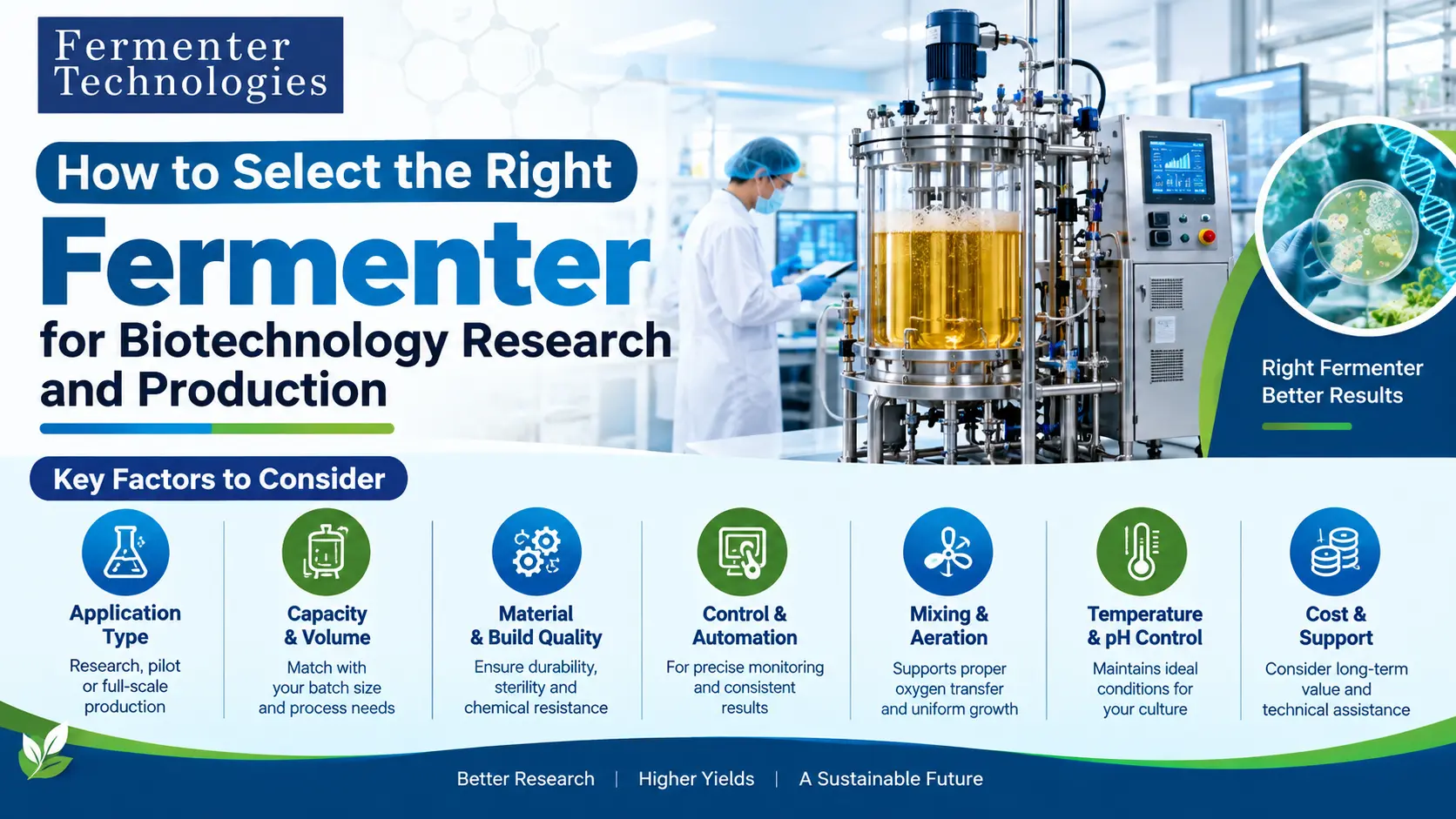
Selecting the right fermenter is an important decision for biotechnology laboratories, research institutions, pharmaceutical companies, and industrial manufacturers. The equipment you choose can directly affect microbial growth, process efficiency, product quality, and production costs. Whether you are conducting laboratory experiments or planning large-scale manufacturing, the fermenter should match your application, process requirements, and future production goals.
A suitable fermenter provides controlled conditions for microorganisms or cells to grow and produce valuable substances such as enzymes, proteins, organic acids, biofuels, and pharmaceutical products. However, selecting the right system requires careful consideration of several technical factors, including working volume, material of construction, agitation, aeration, process control, and sterilization requirements.
In this guide, we explain how to select the right fermenter for biotechnology research and production and what to consider before investing in fermentation equipment.
1. Understand Your Biotechnology Application
The first step in selecting a fermenter is identifying the purpose of your fermentation process. Different applications require different operating conditions, vessel designs, and control systems.
For example, microbial fermentation using bacteria or yeast may require efficient oxygen transfer and continuous agitation. In contrast, mammalian cell culture often needs gentle mixing to protect sensitive cells from excessive shear stress.
Common applications of fermenters include:
- Pharmaceutical production: Manufacturing therapeutic proteins, vaccines, and other biological products.
- Enzyme production: Producing industrial enzymes for food processing, detergents, and biotechnology.
- Microbial fermentation: Growing bacteria, yeast, and other microorganisms for research or manufacturing.
- Food and beverage biotechnology: Supporting the production of fermented ingredients and cultures.
- Biofuel production: Developing biological processes for producing ethanol and other bio-based fuels.
- Research and development: Testing fermentation conditions, evaluating media formulations, and developing new bioprocesses.
Understanding your application helps determine the required vessel configuration, operating range, and automation level.
2. Choose the Appropriate Fermenter Capacity
Fermenter capacity is one of the most important factors to evaluate. The correct size depends on whether the system will be used for laboratory experiments, process development, pilot-scale trials, or commercial manufacturing.
Lab-Scale Fermenters
Lab-scale fermenters are suitable for academic institutions, biotechnology laboratories, and research and development teams. They allow researchers to study microbial growth, optimize fermentation parameters, and conduct small-scale experiments under controlled conditions.
These systems are useful when testing new processes before committing to larger equipment.
Pilot-Scale Fermenters
Pilot-scale fermenters help bridge the gap between laboratory research and industrial production. They allow process engineers to evaluate scale-up challenges, test operating parameters, and assess whether a process can be transferred to larger vessels.
Production-Scale Fermenters
Production-scale fermenters are designed for larger manufacturing requirements. They typically require appropriate instrumentation, process automation, cleaning arrangements, and utility connections to support consistent operation.
When comparing fermenter capacities, consider both total vessel volume and working volume. The working volume represents the amount of liquid or culture used during operation, while the total volume includes the available headspace. Sufficient headspace is important for aeration, foam management, and gas exchange.
3. Evaluate the Material of Construction
The material used to manufacture a fermenter affects its durability, cleanability, corrosion resistance, and suitability for different bioprocesses.
Stainless steel is widely used in industrial fermentation systems because it offers mechanical strength, durability, and compatibility with many cleaning and sterilization procedures.
Stainless steel grades such as SS 304 and SS 316L may be considered depending on the process requirements. SS 316L is often preferred for applications requiring enhanced corrosion resistance, particularly when exposure to certain chemicals or demanding cleaning conditions is expected.
For specialized laboratory applications, glass fermenters may also be suitable because they allow visual observation of the culture and can be useful for experimental work.
Before selecting the material, evaluate the following factors:
- Compatibility with the culture medium and process chemicals.
- Resistance to corrosion under operating conditions.
- Surface finish and cleanability.
- Compatibility with cleaning-in-place (CIP) and sterilization-in-place (SIP), where required.
- Applicable hygiene, validation, and regulatory requirements.
The final material selection should be based on the actual process environment rather than price alone.
4. Check Agitation and Aeration Requirements
Agitation and aeration are essential for many fermentation processes. Agitation helps distribute nutrients, maintain temperature uniformity, and improve mixing. Aeration supplies oxygen to aerobic cultures and supports their metabolic activity.
The required agitation system depends on the organism, broth properties, vessel geometry, and oxygen demand of the process.
When selecting a fermenter, consider the impeller design, mixing speed, motor capacity, gas sparger arrangement, and oxygen transfer requirements. Processes involving viscous media may require different mixing arrangements from those used for low-viscosity liquids.
For aerobic fermentation, oxygen transfer rate (OTR) and dissolved oxygen levels are important operating parameters. An appropriately designed system should provide sufficient oxygen transfer without creating excessive shear that could damage sensitive cells.
It is also useful to evaluate whether the fermenter supports adjustable agitation speed, airflow control, and dissolved oxygen monitoring.
5. Consider Temperature, pH, and Process Control
Accurate process control is essential for achieving consistent fermentation results. Changes in temperature, pH, dissolved oxygen, and other operating conditions can influence cell growth, metabolism, and final product yield.
A suitable fermenter should provide the necessary sensors, controllers, and adjustment mechanisms for your application.
Important control parameters may include:
- Temperature: Maintains the required conditions for microbial or cell growth.
- pH: Helps maintain a suitable environment for biological activity.
- Dissolved oxygen: Monitors oxygen availability in aerobic processes.
- Agitation speed: Controls mixing intensity.
- Airflow and gas composition: Support oxygen supply and other process-specific requirements.
- Foam level: Helps identify and manage excessive foam formation.
Depending on process complexity, a fermenter may use a programmable logic controller (PLC), a human-machine interface (HMI), or specialized fermentation software. Automation can improve repeatability, simplify monitoring, and reduce manual intervention.
6. Review Sterilization and Cleaning Requirements
Contamination can compromise experiments, reduce product quality, and increase manufacturing costs. Therefore, cleaning and sterilization capabilities should be evaluated before purchasing a fermenter.
Laboratory systems may use suitable autoclaving or other validated sterilization procedures, depending on their design. Larger systems may incorporate steam-in-place (SIP) and cleaning-in-place (CIP) arrangements.
CIP helps clean internal surfaces without dismantling the equipment, while SIP uses an appropriate sterilization process to reduce the risk of microbial contamination. The suitability of these systems depends on the equipment configuration and process requirements.
Check the vessel design, seals, valves, sampling ports, and other product-contact components. These parts should support effective cleaning and sterilization and minimize areas where residues or contaminants could accumulate.
For pharmaceutical and other regulated applications, assess documentation, validation requirements, and applicable quality standards before finalizing the equipment.
7. Assess Scalability and Future Expansion
A fermenter that performs well during laboratory experiments may not automatically deliver the same results at a larger scale. Changes in mixing, oxygen transfer, heat removal, and fluid dynamics can affect process performance.
If you plan to move from research to manufacturing, select equipment that supports a structured scale-up strategy. Consider whether the supplier can provide systems across laboratory, pilot, and production scales.
Evaluate the availability of compatible sensors, control systems, vessel configurations, and process documentation. Consistent measurement methods and well-documented operating parameters can make it easier to compare results between scales.
Planning for future requirements can also reduce the need for major equipment changes as your process develops.
8. Compare Customization, Maintenance, and Total Cost
The purchase price is only one part of the total cost of owning a fermenter. Installation, utilities, spare parts, calibration, maintenance, cleaning, and operator training may also affect the overall investment.
Before choosing a supplier, consider the following:
- Availability of application-specific customization.
- Ease of operation and routine maintenance.
- Access to spare parts and technical support.
- Availability of installation and commissioning assistance.
- Compatibility with existing laboratory or production infrastructure.
- Warranty coverage and expected operating costs.
A customized fermenter may be beneficial when a standard configuration does not meet specific process requirements. However, customization should be based on clearly defined technical needs to avoid unnecessary complexity.
9. Why Choose the Right Fermenter Supplier?
Selecting a suitable equipment supplier is just as important as selecting the fermenter itself. An experienced supplier can help assess your application, recommend an appropriate configuration, and identify the essential process-control features.
Fermenter Technologies supports biotechnology and fermentation requirements with equipment solutions designed for different stages of research and production. When evaluating a system, discuss your target working volume, organism or cell type, operating conditions, automation needs, and future scale-up plans.
Request detailed technical specifications and clarify which accessories, sensors, control functions, and cleaning arrangements are included. This helps you compare equipment on a like-for-like basis and select a solution that meets your actual requirements.
Conclusion
Selecting the right fermenter for biotechnology research and production requires a clear understanding of your application, working volume, material requirements, agitation, aeration, process control, sterilization, and scalability needs. Each factor contributes to the equipment’s suitability for your intended process.
By evaluating these requirements before purchasing, biotechnology laboratories and manufacturers can make informed decisions, improve process consistency, and plan for future production demands.
If you are looking for a fermenter for laboratory research, pilot-scale development, or industrial production, Fermenter Technologies can help you explore suitable equipment options based on your process requirements. Discuss your application and technical specifications to identify a fermenter configuration that supports your biotechnology goals.
Frequently Asked Questions (FAQs)
1. How do I select the right fermenter for biotechnology research?
Consider the application, working volume, culture type, temperature and pH requirements, agitation, aeration, sterilization method, and process monitoring needs.
2. What is the difference between a lab-scale and a production-scale fermenter?
A lab-scale fermenter is primarily used for experiments and process development, while a production-scale fermenter is designed to support larger manufacturing volumes and operational requirements.
3. Which material is best for a biotechnology fermenter?
Glass and stainless steel are common options. The best choice depends on the application, chemical compatibility, cleaning requirements, corrosion resistance, and operating conditions.
4. Why are pH and dissolved oxygen important in a fermenter?
pH affects biological activity and nutrient availability, while dissolved oxygen is important for aerobic cultures. Monitoring both helps maintain suitable process conditions.
5. Can the same fermenter be used for research and industrial production?
Some systems support different operating scales, but a single fermenter may not meet every requirement. Vessel capacity, process conditions, automation, and scale-up needs should be evaluated before selection.