Fermentation is an essential process in biotechnology, pharmaceutical manufacturing, food production, and industrial microbiology. It allows microorganisms or cells to produce valuable products such as enzymes, antibiotics, organic acids, biofuels, and other biological compounds. However, the success of a fermentation process depends not only on the microorganism used but also on how nutrients, oxygen, and operating conditions are managed throughout production.
Three widely used fermentation methods are batch fermentation, fed-batch fermentation, and continuous fermentation. Each method has a different approach to nutrient supply, product formation, and process control. Understanding the difference between these methods helps manufacturers select an appropriate fermentation strategy for their production goals.
In this blog, we will explain how these fermentation processes work, their advantages and limitations, and how to choose the right method for your application.
What Is Batch Fermentation?
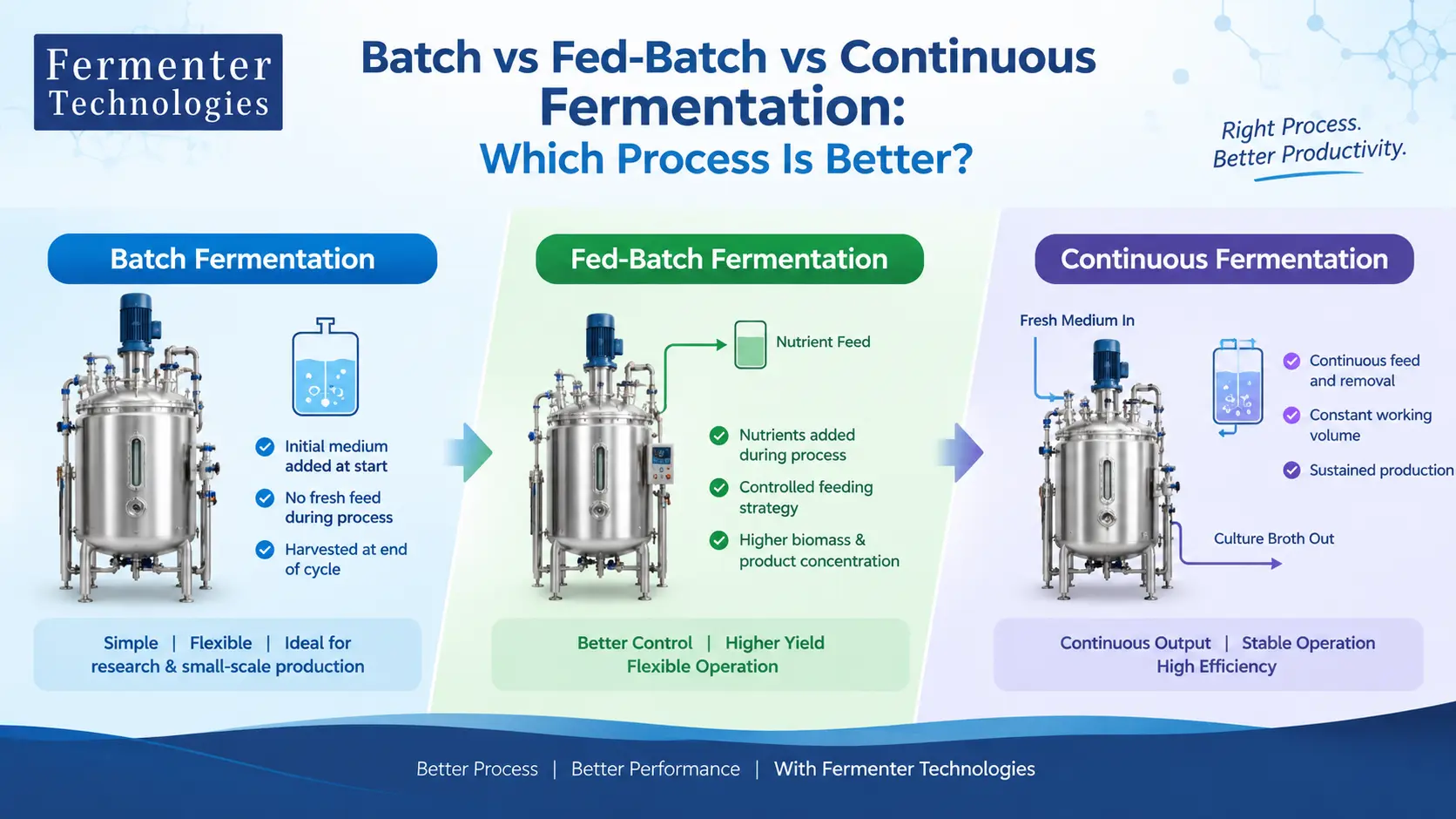
Batch fermentation is a closed-system process in which a fermenter is filled with a prepared culture medium and microorganisms at the beginning of the operation. The fermentation process then continues without adding fresh nutrient medium during the main production phase.
Although nutrients are consumed and products are formed, the total working volume generally remains relatively constant. Depending on the process, air, oxygen, acid, base, or antifoam may still be supplied to maintain suitable operating conditions.
A batch bioreactor is commonly used for applications where a controlled production cycle, product consistency, and separation between batches are important.
Also Read: Lab Scale Bioreactor
How Does Batch Fermentation Work?
The batch fermentation process typically follows these stages:
- The fermenter is cleaned and sterilized according to the required procedure.
- A suitable nutrient medium is prepared and transferred into the vessel.
- The medium is inoculated with the selected microorganism or cell culture.
- Temperature, pH, agitation, and aeration are controlled during fermentation.
- The culture is allowed to produce the desired product until the required endpoint is reached.
- The fermentation broth is harvested, and the vessel is prepared for the next cycle.
A batch culture diagram can help illustrate how the culture progresses through different growth phases, including lag, exponential, stationary, and decline phases. These phases may vary depending on the microorganism and operating conditions.
Advantages of Batch Fermentation
- Simple process design and relatively straightforward operation.
- Suitable for producing different products in separate production cycles.
- Easier to isolate and investigate contamination or process failures within an individual batch.
- Useful for product development, laboratory studies, and smaller production runs.
Limitations of Batch Fermentation
Batch fermentation may require significant downtime between production cycles for cleaning, sterilization, filling, and harvesting. Nutrient depletion and the accumulation of metabolic products can also affect microbial growth and productivity.
For this reason, batch fermentation may not always be the most efficient option for large-scale production requiring continuous output.
What Is Fed-Batch Fermentation?
Fed-batch fermentation is a process in which an initial quantity of culture medium is added to the fermenter, followed by the controlled addition of nutrients during fermentation.
Unlike a conventional batch process, fed-batch operation allows the operator to influence nutrient availability throughout the production cycle. This can help prevent excessive substrate concentrations, reduce unwanted metabolic effects, and maintain suitable growth conditions.
Fed batch fermentation is widely used in biotechnology and pharmaceutical manufacturing, particularly when product formation depends on carefully controlled nutrient feeding.
How Does Fed-Batch Fermentation Work?
The process generally begins like batch fermentation. The vessel is prepared, filled with an initial medium, and inoculated with the selected culture.
As the microorganisms grow and consume nutrients, a concentrated feed solution is introduced according to a planned feeding strategy.
The feed may be supplied at a constant rate, an increasing rate, or through a controlled strategy based on process measurements. The exact method depends on the microorganism, nutrient requirements, and desired product.
Because fresh nutrients are added during the process, the working volume usually increases over time. The culture is harvested after reaching the desired production endpoint.
A fed batch fermentation diagram would show the initial medium and inoculum inside the fermenter, followed by a nutrient feed line entering the vessel during cultivation. The diagram would also include agitation, aeration, temperature and pH control, and a final harvesting stage.
Advantages of Fed-Batch Fermentation
- Improved nutrient control: Nutrients can be supplied according to the culture’s requirements, helping maintain an appropriate growth environment.
- Higher product concentration: For suitable microorganisms and products, controlled feeding can support greater biomass or product accumulation than a conventional batch process.
- Reduced substrate inhibition: Feeding nutrients gradually can help prevent excessive concentrations of substrates that may inhibit microbial growth or product formation.
- Flexible process optimization: Feeding strategies can be adjusted to improve productivity, product quality, or process consistency.
Limitations of Fed-Batch Fermentation
Fed-batch systems require additional feed preparation, pumps, process monitoring, and control strategies. Nutrient feeding must be optimized carefully because an unsuitable feed rate can negatively affect growth, oxygen demand, and product formation.
The increasing working volume also needs to be considered when selecting fermenter capacity.
Also Read: How to Select the Right Fermenter for Biotechnology Research and Production
What Is Continuous Fermentation?
Continuous fermentation is an open-system process in which fresh nutrient medium is continuously introduced into the fermenter while an equivalent quantity of culture broth is continuously removed.
This arrangement allows the working volume to remain approximately constant. Under suitable conditions, microorganisms can be maintained in a relatively stable operating state for an extended period.
Continuous fermentation is often associated with high production efficiency because the system can operate without the repeated filling and harvesting cycles required by batch processes.
How Does Continuous Fermentation Work?
Fresh medium enters the vessel at a controlled flow rate. At the same time, fermentation broth containing microorganisms and products exits the system.
One important operating parameter is the dilution rate, which represents the rate at which fresh medium is introduced relative to the working volume.
If the dilution rate is too high, microorganisms may be removed faster than they can reproduce, causing washout. Therefore, maintaining the desired microbial population requires careful control of operating conditions.
Continuous fermentation can be performed using different configurations, including chemostats and other specialized continuous culture systems.
Advantages of Continuous Fermentation
- Potential for continuous product output.
- Reduced downtime associated with repeated batch preparation and harvesting.
- Suitable for processes that benefit from stable operating conditions.
- Potentially efficient utilization of equipment over extended operating periods.
Limitations of Continuous Fermentation
Continuous systems require reliable process control and careful monitoring of microbial stability.
Contamination can become a significant concern because the culture and nutrient supply remain connected over an extended operating period. Changes in microbial characteristics, nutrient availability, or operating conditions may also affect product quality.
Continuous fermentation is therefore not automatically the best option for every industrial application.
Batch, Fed-Batch and Continuous Fermentation: Key Differences
The main difference between batch, fed-batch, and continuous fermentation lies in how nutrients are supplied and how the culture broth is removed.
| Parameter | Batch fermentation | Fed-batch fermentation | Continuous fermentation |
|---|---|---|---|
| Nutrient supply | Initial medium added at the beginning | Nutrients added during the process | Fresh medium supplied continuously |
| Product removal | Generally harvested at the end | Generally harvested at the end | Culture broth removed continuously |
| Working volume | Usually remains relatively constant | Usually increases during feeding | Usually remains relatively constant |
| Operating style | Separate production cycles | Separate cycles with controlled feeding | Extended continuous operation |
| Process control | Comparatively simple | Requires feed-rate control | Requires continuous flow and culture control |
| Common use | Product development and batch production | Biomass and product concentration optimization | Processes requiring sustained production |
Which Fermentation Process Is Better?
There is no single fermentation method that is best for every application. The right choice depends on the microorganism, product characteristics, production scale, and required operating conditions.
Choose Batch Fermentation When
Batch fermentation is a suitable option when:
- Production involves different products or separate manufacturing campaigns.
- The process requires straightforward operation and clear production cycles.
- Product development or laboratory experimentation is a priority.
- Cleaning, sterilization, and harvesting between batches are manageable.
Choose Fed-Batch Fermentation When
Fed-batch fermentation may be preferable when:
- Nutrient concentration needs careful control.
- Excess substrate can inhibit growth or product formation.
- Higher biomass or product concentration is an important objective.
- The production process benefits from a flexible nutrient feeding strategy.
Choose Continuous Fermentation When
Continuous fermentation may be appropriate when:
- The product can be manufactured under stable, sustained operating conditions.
- The microorganism remains productive and stable over extended periods.
- Reliable process control and contamination management are available.
- Continuous output provides a meaningful operational advantage.
Applications of Different Fermentation Processes
Batch fermentation is frequently used in research, specialty products, and production processes where separate manufacturing cycles are practical.
Fed-batch fermentation is widely applied in microbial biotechnology, enzyme production, and certain pharmaceutical processes where nutrient feeding can improve process performance.
Continuous fermentation is used in selected industrial biotechnology and microbial production applications where stable long-term operation is achievable.
The actual process selection should be based on product-specific studies rather than assuming that one method will always provide higher productivity or better quality.
Conclusion
Batch, fed-batch, and continuous fermentation are three important approaches to industrial bioprocessing. Batch fermentation offers simplicity and flexibility, fed-batch fermentation provides greater control over nutrient availability, and continuous fermentation supports sustained production under suitable operating conditions.
For manufacturers, choosing the right fermentation method requires evaluating product requirements, microbial behaviour, process control capabilities, and production economics.
Fermenter Technologies supports the development and selection of fermentation equipment suited to different bioprocessing requirements. By understanding the differences between these fermentation methods, businesses can make more informed decisions about equipment configuration and process design, helping build reliable and efficient fermentation operations.