Bioreactors play an important role in modern biotechnology, pharmaceutical manufacturing, food processing, enzyme production, biofertilizers, and many other industries. They provide a controlled environment where microorganisms, animal cells, plant cells, or other biological materials can grow and produce a desired product.
But how does a bioreactor work? The basic idea is simple: a bioreactor maintains the right conditions for biological growth by controlling factors such as temperature, pH, dissolved oxygen, agitation, aeration, and nutrient supply. As the process moves from research to commercial production, the equipment becomes larger and more sophisticated while maintaining the same fundamental biological requirements.
From a small lab scale bioreactor used for research to a large industrial bioreactor used for commercial fermentation, understanding the working principle is essential for selecting the right equipment and achieving consistent results.
What Is a Bioreactor?
A bioreactor is a specially designed vessel in which biological reactions are carried out under controlled conditions. Depending on the application, it may be used to cultivate microorganisms such as bacteria and yeast or to grow cells for producing pharmaceuticals, enzymes, vaccines, biofuels, and other biological products.
Most bioreactors are manufactured using stainless steel or other materials suitable for the process. The vessel is equipped with different components for mixing, aeration, temperature control, pH monitoring, and process measurement.
In simple terms, a bioreactor works like a controlled environment where the biological process can take place safely, efficiently, and repeatedly.
Also Read: What Is a Fermenter? Types, Working Principle & Applications
How Does a Bioreactor Work?
The working principle of a bioreactor involves maintaining an ideal environment for the growth of microorganisms or cells. Before starting the process, the vessel and required media are prepared and sterilized according to the application.
The selected microorganisms or cells are then introduced into the vessel. During fermentation or cell cultivation, the bioreactor continuously monitors and controls important process parameters.
Agitation keeps the contents properly mixed, while aeration supplies oxygen when required. Sensors monitor parameters such as temperature, pH, and dissolved oxygen. The control system can automatically adjust different operating conditions to keep the process within the required range.
As the microorganisms or cells grow, they consume nutrients and produce the desired product along with metabolic by-products. At the end of the process, the fermented broth or cell culture is removed for downstream processing.
Therefore, the basic working sequence can be understood as:
Preparation → Sterilization → Inoculation → Controlled Growth → Monitoring → Fermentation → Harvesting
Major Components of a Bioreactor
Although bioreactor designs can vary depending on the application, several components are commonly found in modern systems.
Vessel
The vessel provides the controlled environment where fermentation or cell cultivation takes place. Stainless steel is commonly used for industrial equipment because of its strength, durability, cleanability, and suitability for hygienic processes.
Agitator
The agitator mixes the culture medium and helps maintain uniform conditions throughout the vessel. Proper agitation is particularly important when nutrients, temperature, and dissolved oxygen need to be distributed evenly.
Aeration System
In aerobic fermentation, microorganisms require oxygen for growth and production. The aeration system introduces sterile air into the culture, while the agitator helps transfer oxygen from the air into the liquid.
Sensors and Probes
Modern bioreactors use sensors to monitor parameters such as pH, temperature, dissolved oxygen, pressure, and sometimes other process variables. These measurements help operators maintain stable process conditions.
Temperature Control
Microorganisms and cells generally require a specific temperature range for optimum growth. A heating or cooling system helps maintain the required temperature throughout the process.
Control System
The control system brings different components together. Depending on the design, it can automatically regulate agitation speed, temperature, pH, aeration, dissolved oxygen, and other parameters.
What Is a Lab Scale Bioreactor?
A lab scale bioreactor is designed primarily for research, experimentation, process development, and optimization. It allows scientists and engineers to study biological processes before moving them to larger production systems.
Lab-scale units are generally smaller and easier to operate than production equipment. Researchers can use them to test different culture media, microorganisms, agitation speeds, aeration rates, pH levels, and temperature conditions.
One of the biggest advantages of a lab scale bioreactor is flexibility. Researchers can perform multiple experiments with relatively small quantities of material, helping them identify the most suitable process conditions before investing in large-scale production.
Lab-scale bioreactors are commonly used in:
- Biotechnology research
- Pharmaceutical development
- Enzyme production
- Microbial fermentation
- Research on biofertilizers
- Food and beverage applications
- Process optimization
- Cell culture studies
The information obtained at laboratory scale becomes valuable when the process is transferred to pilot and industrial production.
Moving from Lab Scale to Industrial Fermentation
Scaling up a biological process is not simply a matter of making the vessel larger. Conditions that work well in a small vessel may behave differently in a large tank.
For example, oxygen transfer, mixing time, heat removal, and power consumption can change considerably as the working volume increases. Engineers therefore need to carefully evaluate the process before transferring it to larger equipment.
A typical development path can include:
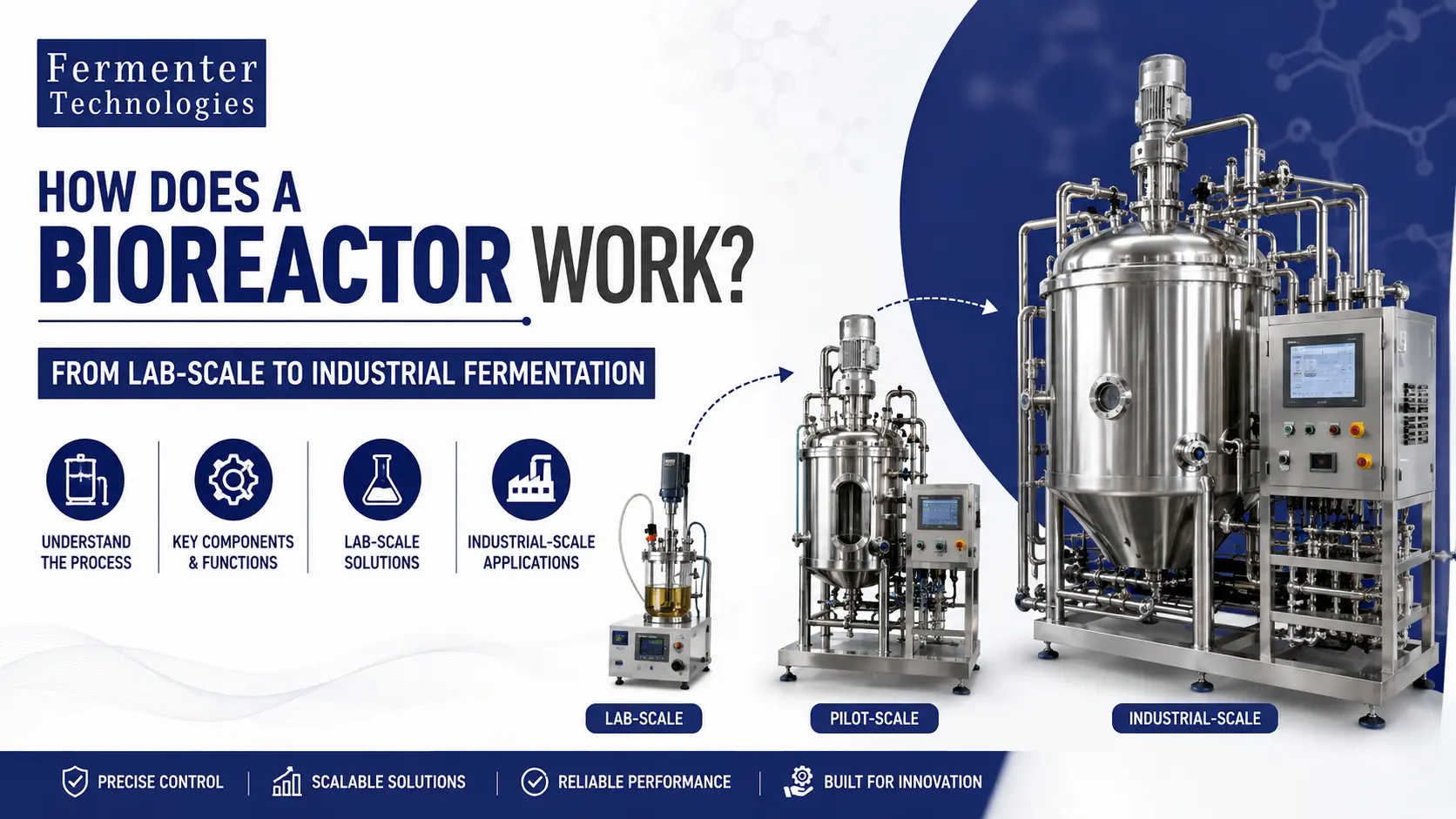
Laboratory Scale → Pilot Scale → Production Scale
At the laboratory stage, the focus is usually on understanding and optimizing the biological process. Pilot-scale equipment helps verify whether the process can be reproduced at a larger volume. Once the process has been established, it can be transferred to an industrial production system.
What Is an Industrial Bioreactor?
An industrial bioreactor is designed for large-scale production where biological processes need to operate reliably and consistently. These systems can have significantly larger working volumes than laboratory equipment and generally incorporate advanced monitoring, automation, cleaning, and process-control systems.
Industrial bioreactors are used for applications such as pharmaceutical production, enzymes, biofertilizers, probiotics, fermentation-based chemicals, food ingredients, and other biotechnology products.
Because production batches can represent significant quantities of raw materials and finished products, industrial systems require careful control of parameters such as temperature, pH, dissolved oxygen, agitation, pressure, and airflow.
How Is Industrial Fermentation Controlled?
Industrial fermentation requires consistent conditions throughout the production cycle. Automated control systems can continuously receive information from sensors and adjust operating parameters when necessary.
For example, if the dissolved oxygen level drops below the required range, the system may increase aeration or agitation. Similarly, if the temperature begins to move away from the set point, the cooling or heating system can respond accordingly.
This level of control helps manufacturers achieve greater batch-to-batch consistency and reduces the need for constant manual intervention.
Applications of Bioreactors
Bioreactors are used across a wide range of industries because biological processes can produce valuable products efficiently under controlled conditions.
Common applications include:
- Pharmaceuticals: Production of biological products, vaccines, enzymes, and other pharmaceutical ingredients.
- Biotechnology: Cultivation of microorganisms and cells for research and commercial applications.
- Food Industry: Production of fermented foods, ingredients, enzymes, and cultures.
- Biofertilizers: Cultivation of beneficial microorganisms used in agricultural products.
- Enzyme Production: Manufacturing enzymes used in food processing, detergents, textiles, and other industries.
- Biofuels: Fermentation processes involved in producing ethanol and other biological fuels.
Why Proper Bioreactor Design Matters
The performance of a bioreactor depends heavily on its design and the process requirements. Mixing, oxygen transfer, temperature control, sterilization, instrumentation, and cleaning all need to work together effectively.
A properly designed system can help maintain stable operating conditions, improve process efficiency, reduce contamination risks, and support consistent product quality.
This is particularly important when scaling from laboratory research to commercial manufacturing.
Conclusion
So, how does a bioreactor work? It creates and maintains a controlled environment in which microorganisms or cells can grow and carry out biological reactions efficiently. Agitation, aeration, temperature control, pH regulation, sensors, and automation work together to maintain suitable conditions throughout the process.
A lab scale bioreactor helps researchers develop and optimize a biological process, while pilot and production systems help transfer that process toward commercial manufacturing. At the industrial level, an industrial bioreactor provides the capacity, process control, and reliability required for continuous or batch-based production.
For companies working in biotechnology, pharmaceuticals, food processing, biofertilizers, enzymes, and fermentation-based industries, choosing the right bioreactor design is an important step toward achieving reliable and scalable production. Fermenter Technologies provides bioreactor and fermenter solutions designed around different research, pilot-scale, and industrial processing requirements.