Bioreactors are the backbone of modern biotechnology and industrial fermentation. They provide a controlled environment where microorganisms and cells can grow under ideal conditions to produce valuable biological products. Among the various types of bioreactors available today, the stirred tank bioreactor is the most widely used because of its versatility, excellent mixing efficiency, and ability to support a wide range of biological processes.
From pharmaceutical manufacturing and vaccine production to enzyme development and biofertilizer production, stirred tank bioreactors have become an essential part of industrial biotechnology. Their advanced design ensures efficient oxygen transfer, uniform nutrient distribution, and precise control over operating conditions, making them suitable for both research laboratories and large-scale production plants.
In this blog, Fermenter Technologies explains everything you need to know about the stirred tank bioreactor, including its working principle, design, components, advantages, and industrial applications.
What is a Stirred Tank Bioreactor?
A stirred tank bioreactor is a cylindrical vessel equipped with a mechanical agitation system that continuously mixes the culture medium during fermentation or cell cultivation. The primary purpose of stirring is to ensure that microorganisms receive an even supply of nutrients, oxygen, and temperature throughout the vessel.
Unlike other reactor designs that depend mainly on air circulation, a stirred tank bioreactor uses an impeller-driven mixing mechanism. This allows better oxygen transfer and homogeneous mixing, resulting in improved microbial growth and higher product yields.
Today, stirred tank bioreactors are used extensively for cultivating bacteria, yeast, fungi, algae, and even mammalian cells in biotechnology and pharmaceutical industries.
Working Principle of a Stirred Tank Bioreactor
The working principle of a stirred tank bioreactor is based on maintaining a controlled environment that supports biological growth. The process begins by sterilizing the reactor to eliminate contaminants. Once the vessel is sterile, a nutrient-rich culture medium is introduced, followed by inoculation with the desired microorganisms or cells.
An agitator fitted with specially designed impellers rotates continuously inside the vessel. This mechanical stirring keeps nutrients evenly distributed while preventing microorganisms from settling at the bottom. At the same time, sterile air is introduced through a sparger located near the base of the reactor. The rotating impellers break the air into fine bubbles, increasing oxygen transfer throughout the culture medium.
Modern stirred tank bioreactors are equipped with advanced sensors that continuously monitor temperature, pH, dissolved oxygen, foam formation, and agitation speed. Automated PLC and SCADA systems make real-time adjustments to maintain ideal fermentation conditions, ensuring consistent productivity and product quality.
Also Read: Bioreactor: Design, Principle, Parts, Types, Uses, Diagram
Stirred Tank Bioreactor Design
The efficiency of a stirred tank bioreactor depends greatly on its design. Every component is engineered to maximize mixing, improve oxygen transfer, and maintain sterile operating conditions.
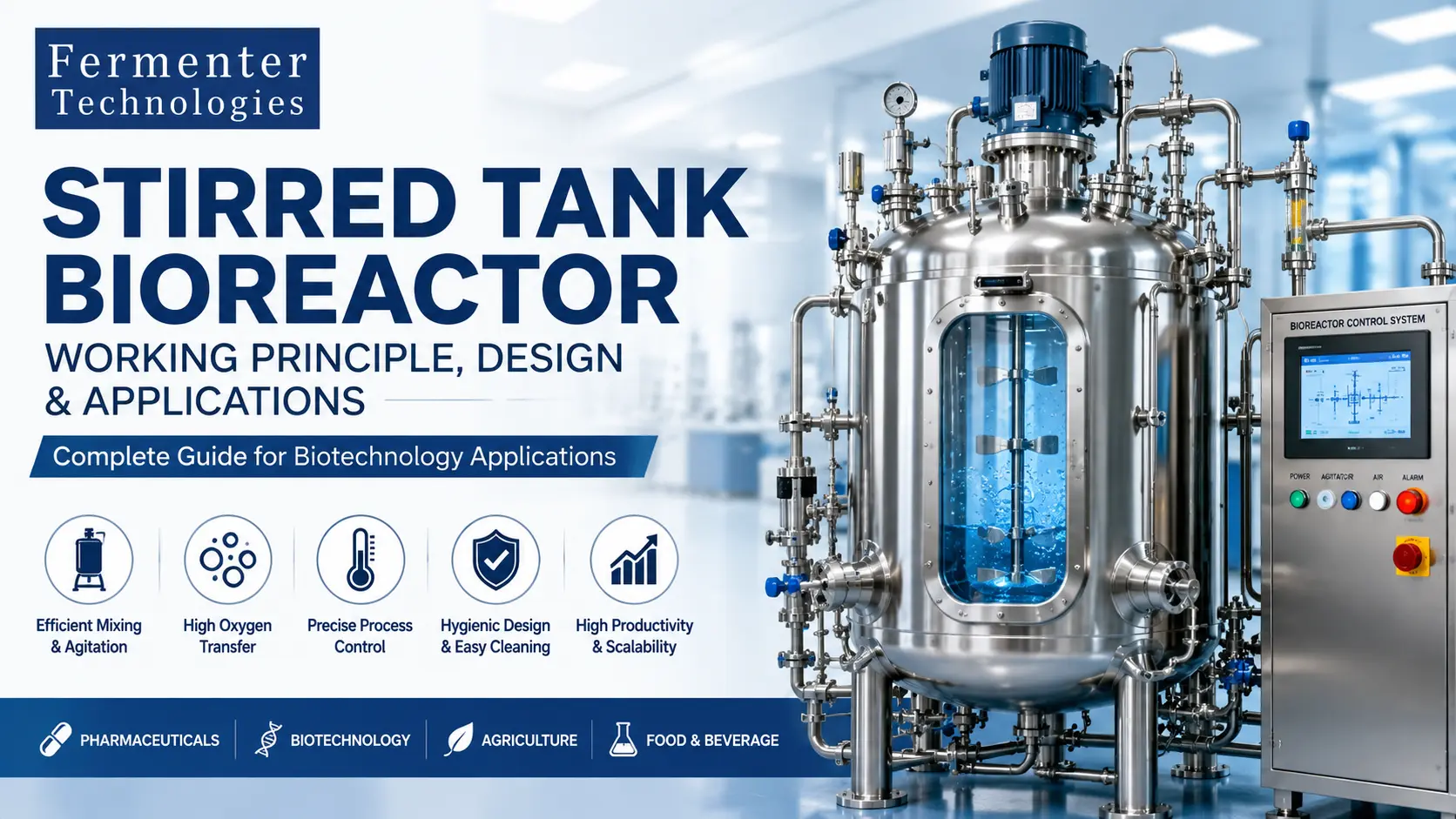
The reactor vessel is generally manufactured from high-quality SS316L stainless steel, which offers excellent corrosion resistance, durability, and easy cleaning. Its cylindrical shape with a dished top and bottom promotes efficient fluid circulation and minimizes dead zones.
The agitation system is one of the most important elements of the design. Multiple impellers mounted on a central shaft rotate at controlled speeds to mix the culture medium effectively. Baffles fixed to the inner wall prevent vortex formation, ensuring better mixing and oxygen distribution.
A sparger installed at the bottom introduces sterile compressed air, while a cooling jacket maintains the desired operating temperature. Sensors continuously monitor critical process parameters, and automated control systems regulate the process throughout fermentation.
This well-planned design allows stirred tank bioreactors to handle laboratory-scale research as well as large industrial production with consistent performance.
Main Components of a Stirred Tank Bioreactor
A modern stirred tank bioreactor consists of several essential components that work together to achieve efficient biological production.
The bioreactor vessel provides a sterile chamber for microbial growth. The agitator shaft and impellers continuously mix the culture medium, while baffles improve mixing efficiency by preventing vortex formation.
The sparger supplies sterile air or oxygen required for aerobic fermentation. Temperature sensors, pH probes, dissolved oxygen sensors, and foam sensors continuously monitor process conditions. The cooling jacket regulates temperature, while the PLC and SCADA control system automates the entire operation, reducing manual intervention and improving production consistency.
Advantages of a Stirred Tank Bioreactor
One of the biggest reasons for the popularity of the stirred type bioreactor is its ability to provide highly efficient mixing and process control. Continuous agitation ensures uniform nutrient distribution and excellent oxygen transfer, allowing microorganisms to grow rapidly and produce higher yields.
Another major advantage is its versatility. Stirred tank bioreactors can support microbial fermentation, enzyme production, vaccine manufacturing, recombinant protein production, cell culture, and many other biotechnology processes.
The design also allows precise monitoring of critical parameters such as pH, dissolved oxygen, temperature, agitation speed, and foam formation. Automated control systems improve process reproducibility while reducing human error.
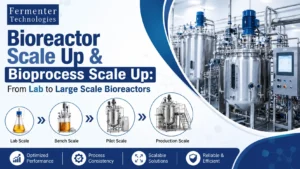
Furthermore, these reactors are highly scalable. A process developed in a laboratory-scale reactor can be successfully transferred to pilot-scale and industrial production with minimal modifications. This makes stirred tank bioreactors ideal for commercial manufacturing.
Simple Stirred Tank Bioreactor
A simple stirred tank bioreactor is commonly used in laboratories, educational institutions, and research facilities for small-scale fermentation studies. Although simpler in design than industrial models, it contains the essential components required for biological cultivation, including a vessel, agitator, sparger, temperature sensor, and basic control system.
Researchers use simple stirred tank bioreactors to study microbial growth, optimize fermentation parameters, evaluate new microbial strains, and develop production processes before scaling them to commercial manufacturing. Their compact design, ease of operation, and lower operating cost make them highly suitable for research and academic applications.
Industrial Applications of Stirred Tank Bioreactors
The stirred tank bioreactor is one of the most versatile systems used across multiple industries.
In the pharmaceutical industry, it is widely employed for producing antibiotics, vaccines, insulin, hormones, recombinant proteins, and monoclonal antibodies. Biotechnology companies use stirred tank bioreactors for microbial cultivation, enzyme production, genetic engineering, and cell culture research.
Food and beverage manufacturers rely on these bioreactors to produce probiotics, yeast, dairy cultures, organic acids, and fermented food products. Agricultural industries use them for manufacturing biofertilizers, biopesticides, and microbial inoculants that support sustainable farming.
In addition, stirred tank bioreactors play a significant role in biofuel production, wastewater treatment, environmental biotechnology, and industrial enzyme manufacturing.
Factors to Consider Before Choosing a Stirred Tank Bioreactor
Selecting the right stirred tank bioreactor depends on several important factors. Manufacturers should evaluate production capacity, microorganism type, oxygen demand, agitation requirements, automation level, sterility standards, and future scalability before investing in equipment.
The material of construction should also be considered carefully. SS316L stainless steel offers excellent corrosion resistance and hygienic performance, making it the preferred choice for pharmaceutical and biotechnology industries.
Choosing a reactor with advanced PLC and SCADA automation further improves process accuracy, production consistency, and operational efficiency.
Why Choose Fermenter Technologies?
Fermenter Technologies is a trusted manufacturer of advanced fermenters and bioreactors designed for laboratory research, pilot-scale studies, and industrial production. Our stirred tank bioreactors are engineered using premium SS316L stainless steel and incorporate intelligent PLC and SCADA automation for precise process control.
We offer customized solutions tailored to pharmaceutical, biotechnology, food processing, agricultural, and fermentation industries. From equipment design and manufacturing to installation, commissioning, validation, and after-sales support, our experienced team ensures reliable performance and long-term operational success.
Whether you require a laboratory reactor for research or a fully automated industrial fermentation system, Fermenter Technologies delivers solutions that combine innovation, quality, and efficiency.
Conclusion
The stirred tank bioreactor remains the most widely used reactor in biotechnology because of its superior mixing efficiency, excellent oxygen transfer, and precise process control. Its robust design supports a wide range of biological processes, from laboratory research to full-scale industrial production, making it indispensable for pharmaceutical, food, agricultural, and biotechnology industries.
Whether you are working with a simple stirred tank bioreactor for research or a large stirred type bioreactor for commercial manufacturing, selecting the right system is essential for achieving consistent product quality and maximum productivity. At Fermenter Technologies, we provide advanced stirred tank bioreactors designed to meet the evolving needs of modern biological manufacturing, helping industries achieve efficient, reliable, and scalable production.